anil

Tuesday, November 20, 2012

The Indian billionaires

In an interesting article, the Financial Times talks to some of the new Indian billionaires and what makes them tick.

http://www.ft.com/cms/s/2/be255dd2-2eb6-11e2-9b98-00144feabdc0.html#axzz2CW2lRqzl


India’s billionaires club

Hear the views and taste the lifestyle of some leading members of India’s growing elite
Rakesh Jhunjhunwala©Atul Loke/Panos Pictures
Rakesh Jhunjhunwala, self-made stock market tycoon, in Mumbai
Five hours in, and I’m beginning to understand the warnings: an evening on the town with Rakesh Jhunjhunwala is not to be taken lightly. A night that began over a $450 bottle of whisky, on the 15th floor terrace outside his office in the heart of downtown Mumbai, has wound on to a local watering hole, and now to a favourite Chinese restaurant nearby. I am much the worse for wear. He is just warming up.
Often known as “India’s Warren Buffett”, Jhunjhunwala is a colourful financier with outspoken views to match his stock market acumen. He says he started investing with just $100 of start-up capital. Now he has $1.25bn, according to the latest Forbes rankings, the first to join India’s growing band of billionaires by working the markets alone. He cuts an outsize figure too. This is partly physical: Jhunjhunwala is a large man, with a rotund face and a protruding stomach that gives his white shirt a tent-like appearance; his bulky diamond ring is sufficiently sizeable to distract from the many cigarettes he smokes. “I only manage my own money, not for anyone else,” he tells me as the night gets going, a generous glass of Johnnie Walker Blue in hand. “I like my freedom, boss. I don’t want to be answerable to anyone. F*** ’em. That is why I can say what I want.”

More

ON THIS TOPIC

IN FT MAGAZINE

Even more than this plain-speaking, however, Jhunjhunwala has won recognition for his relentlessly upbeat views about Indian growth. Known as the “big bull”, he made his fortune spotting undervalued companies which went on to prosper as the country’s economy leapt forward over the past decade. “The factors that drive India’s growth,” he says, “are irreversible – the democracy, the demographics, the entrepreneurship. Much more is going to come in the future.”
It was these investments that in turn propelled the 52-year-old investor from a modest middle-class background into his nation’s burgeoning billionaires club. Ten years ago this group was not yet half-a-dozen strong; today it has grown to 61, with a combined worth of $250bn, which on some measures places India second only to Russia among major economies for concentration of wealth among its very richest citizens.
This is the story of modern India, one in which huge fortunes are amassed as the country’s old system of soggy socialism and international isolation is overturned, and sectors from banking and media to telecoms and financial markets are transformed by international investment and increased competition. As a result, growth rates rose ever-higher, coming within a whisker of 10 per cent in 2010 and prompting talk that India might soon roar past China to become the world’s fastest-growing major economy.
But it is a story with a darker side too. Some of those who prospered in this heady moment, including Jhunjhunwala himself, made money with their reputations intact. But others rose less cleanly, building fortunes off the back of their country’s lethargic but graft-ridden political system – part of the reason why the country’s growth has flagged badly over the last year. And it is this second group, the beneficiaries of a nexus between India’s government and its tycoon class, that lead many to worry that an era of crony capitalism is now undermining the country’s hopes for future growth and development.
“It really is a remarkable change, which has happened mostly over the last 10 years or so,” says Ashutosh Varshney, an academic at Brown University who has compared contemporary India to America’s “Gilded Age”, the late 19th-century era of robber barons and rapacious industrial capitalism. “Any economy that grows as quickly as India’s has is bound to generate enormous human temptations. These very rich people have started buying politics, and the great churning in India you see against corruption is essentially about the purchase of politics by the wealthy.”
So who are India’s new business elite, and what do they think about the wealth amassed by their peers? I decided to meet a handful of them, as part of my attempt to answer a more simple question: is this extraordinary rise in the power of the hyper-rich harming their country?
. . .
I step into Rakesh Jhunjhunwala’s office on a sweaty October evening, just after the end of the monsoon rains, to find him parked behind his desk, watching data whizz by on five computer terminals. He seems glued to the screens, stopping only occasionally to grab the phone and bark “buy” or “sell” instructions in Hindi. I can make out only the amounts, which appear to involve millions of dollars.
The terrace outside provides a pleasing view over India’s financial capital, with glimpses between the nearby tower blocks to Malabar Hill, the elite neighbourhood over the bay where Jhunjhunwala lives with his wife and three young children. A little further to the north stands Antilia, the 27-storey home of Mukesh Ambani, India’s richest man. This grandiose building, completed in 2010, came to symbolise the excesses of India at that time: a residence that probably cost more than $500m, standing atop a city more than half of whose residents live in slums.
Yet while Ambani inherited the basis of his fortune, a trait he shares with most of his fellow billionaires, Jhunjhunwala came from more modest beginnings. “The Ambanis and all these big industrial houses, they are empire builders. They have inherited legacies. I inherited no legacy,” he tells me. Instead he picked up an early interest in stocks from his father, a minor government official who talked about markets with friends in the evening, over a drink. “I was a very, very curious child,” he says, and a teenage interest in markets soon led him to become a full-time trader and investor. “It was the Wild West,” he says of Dalal Street in the early 1980s, the equivalent of Wall Street in a city still then known as Bombay. “But I always thought India would shed its socialism, and if there were new temples in India, they would be its stock markets.”
A few glasses later, I ask about his approach to investing, and am given an early taste of his ribald sense of humour. “Markets are like women,” he says: “Always commanding, always mysterious, always uncertain, always volatile, always exciting!” He then asks me to turn off my recorder before launching into a bawdy (and clearly frequently repeated) soliloquy on why markets are also like sex, which I pledge not to repeat.
The prior line was one I’d actually heard him use before, during a bravura, finger-jabbing performance at a conference the previous week, when he conducted a screaming argument with a fellow panellist, and won laughs for claiming that Mumbai would never succeed as a global financial centre until it had better strip-bars and nightclubs. This is the flamboyant side to his character: one confirmed by the Bentley he keeps at home, the private jet he says he plans to buy, and the 50th birthday party for which he flew more than 200 friends to Mauritius.
Yet a capacity to shock and a taste for luxury aside, it was Jhunjhunwala’s eye for equity market bargains that truly brought him to prominence, and in particular his predictions of a boom at the start of the last decade. In 2002, he wrote an article arguing India was “at the threshold of a secular and structural bull market”, as government reforms bore fruit. “I am shouting at the top of my voice in 2003,” he recalls, as we move on towards dinner. “Buy, buy, buy! Sell your bloody wife’s jewellery, and buy!’”
It was a prescient call. India’s markets went on a five-year tear, and a number of the companies in which he invested rose in value many times over. The country flourished too, with a jump in growth rates buoyed by a flood of international money and record corporate profits – and the list of dollar billionaires grew ever more crowded, Jhunjhunwala now among them.
Other fast-growing emerging markets have witnessed comparable expansions among their wealthiest citizens, of course. Yet beyond the rise in the number of billionaires and the absolute size of their riches, India’s boom was also remarkable for the sharp rise in the share of the country’s wealth this tiny group held – a fact confirmed in research by Michael Walton of Harvard University and Aditi Gandhi of Delhi’s Centre for Policy Research. Their analysis shows a striking increase in these holdings, relative to the size of the economy. In 2003, the billionaires’ share stood at just 1.8 per cent; five years later it had ballooned to 22 per cent. Much of this flowed from the rocketing stock market, which bumped up the equity the tycoons held in their own companies. This in turn explains why the figure has since fallen back in the aftermath of the global financial crisis, to around 10 per cent.
Even so, some of those who prospered during India’s great opening up say such increases in wealth are not a special cause for concern. Take B.K. Modi, a charismatic industrialist who also often turns up in Forbes’ rich lists, who made his fortune by tying up with western companies like Xerox, as they sought entry into India’s fast-growing markets.
“There was always this affluent lifestyle in India,” he tells me, sitting in his plush and recently refurbished residence overlooking Mumbai’s exclusive Juhu beach, wearing his usual straw-coloured hat. “It is not something especially new. Some people say business people have become the new Maharajas,” he says. “But if someone has created wealth through growing share value, that is accepted as OK.”
. . .
Subhash Chandra
Subhash Chandra, media mogul, founder of India’s first satellite TV station
This is a sentiment I also hear fromSubhash Chandra, the head of ZeeTV, which 20 years ago opened up as India’s first satellite television station, kicking off a raucous media revolution in a country that, until then, had just one stodgy government-backed station. Over the next two decades, Chandra has become arguably his country’s most prominent media tycoon. He is now also its 23rd richest man, worth $2.9bn.
“Our country has come through 400 or 500 years of slavery, right from the Moguls to the Portuguese, then to the British,” he tells me in his office in midtown Mumbai. He’s dressed in a sharp suit, with a distinctive, elegant stripe of white hair above his forehead. “Our people were suppressed for maybe 800 years. That is changing.”
Others see the last decade as a less positive period, where wealth has become increasingly bound up with another of the country’s most vexing problems: corruption. One is Rajeev Chandrasekhar, a former technology entrepreneur. In 2005 he sold BPL Mobile, his telecoms business, for Rs44bn ($817m), taking his own place in the upper echelons of India’s monied class, before moving into politics as an independent member of the country’s upper house of parliament.
“Until roughly the year 2000, becoming a billionaire was something that everybody saw as a good thing in India. They saw it as a coming of age,” he explains, as we sit in his home in a fancy neighbourhood of New Delhi. “Now being wealthy has been given a bad name.”
The generation that rose in the period immediately after India’s reforms in the early 1990s amassed fortunes in areas such as information technology and outsourcing, he contends. However, recent times have seen a more troubling economic trend. “In the last decade, almost all of the billionaires created in India have been created because of the proximity to politics,” he says. “They have been created in specific areas where government policy determines whether you make a billion or you don’t, which includes land, real estate, infrastructure, and natural resources.”
Rajeev Chandrasekhar©Jyothy Karat
Rajeev Chandrasekhar, venture capitalist and independent member of parliament
It is a claim at least partially backed up by Walton and Gandhi’s research, which found that nearly half of India’s billionaires have made their money in sectors that the duo describe as “rent-thick” – ie where profit is dependent on “economic rents” for access to scarce resources, such as land or the telecoms spectrum, which are typically only available via government permissions. Such sectors can be lucrative, but they also often provide a Petri dish for corruption.
“I don’t come from the school of thought that creating a business is bad, or that having a jet is bad, or that having a Lamborghini is bad,” Chandrasekhar says. “I have a Lambo, I have a jet. I enjoy all of that.” But he suggests that India’s trend towards cronyism is worsening, and that it has taken an even more malevolent turn of late, as politicians find ways not just to extract money from the wealthy proprietors of businesses, but also to become such themselves.
“We have a completely unique phenomenon in India, which I call political entrepreneurship, that has taken root in the last five to six years,” he says. “They [the politicians] are saying: ‘We don’t want briefcases full of cash and Swiss bank accounts and all that any more. We want to own businesses ourselves. We want equity stakes.’ ”
The result is a cadre of Indian politicians who are thought to have quietly amassed gigantic fortunes by helping companies they themselves own, either directly or indirectly through their families or associates. A small number, Chandrasekhar hints, would take their place on Forbes’ billionaires list, had they not cleverly disguised the true extent of their gains.
. . .
Such claims cast a shadow over India’s economic rise. The country has become more prosperous over the last decade. Its elite has become much richer, and is set to become wealthier still. A recent report from Kotak, a Mumbai-based brokerage, suggested that some 62,000 Indians had a net worth of at least Rs250m ($4.6m) last year, and that group is set to grow more than threefold by 2015.
But the nation has become less equal too, and the benefits of growth seem to have flowed disproportionately to those at the very, very top. It is a development that leads some to issue stark warnings. “If you don’t make sure that the wealth is distributed to a wider group of people, if you are amassing the wealth to yourself more and more, I’m telling you, a day will come when people will take you out from your houses, and throw you out,” says ZeeTV’s Chandra.
Others are more phlegmatic, believing that public anger will ultimately force a response from the political system. “Democracy is being corrupted and subverted in India,” says Brown University’s Varshney. “But democracy has a way of self-correcting, just as it did in a similar period in America more than a century ago.”
As my evening with Jhunjhunwala comes to an end, he offers me a lift home and I flop unsteadily into the back of his Mercedes, while he ponders the same issue. The business empires, the industrial conglomerates and inherited family dynasties that dominate his country’s business landscape will decline in time, he says after some thought. He goes on to cite an old Hindu saying, that wealth will always peter out by the time it reaches the seventh generation. For himself, he says he avoids such troubles simply by steering clear of politics.
“I have no dealings with the government. I haven’t taken any licences, I don’t own any coal mines, I have no politicians as friends, I never go to a government office.” And last year he also announced plans to give a quarter of his fortune to charity, a move inspired by the investor to whom, in India at least, he is so frequently compared – Warren Buffett, who has cajoled many of the world’s wealthiest into handing out more of their money.
“Maybe I’ll make it half, who knows?” he says. In the meantime, his ambition remains the same. “I want to earn the greatest wealth in the world, but with the greatest practical integrity.” It is an ambition that many of his countrymen might wish others like him would share.
James Crabtree is the FT’s Mumbai correspondent


Thursday, November 15, 2012

Papa tells me a story- about my family tree


Last week my grandson Nikhil sent me this story....

"One day Papa started telling me a story about my family tree because Mama said that it was important for me to know where I came from. ( I thought I knew where I came from - but that is another story!) Oh there are so many stories to tell !).  And what is a family tree anyway?

First there was me


Then there was my papa- yes that handsome dude is my papa

 And then there is that hottie- my sweetie pie Mama

Then there is the wise old man of the family - white beard and all - my dada
That is my " all knowing grandma" - I call her Dadi sometimes when I can find the words!
One day papa told me that even dada had his own papa- yes that stern looking person is him. Imagine my papa has a dada too. But he is no longer around. But look at that little guy in front- papa says that that is my dada- can you believe it. I dont! Where is the white beard, I ask you?


This was my grandma - says Papa, he tell so many stories- my sweet dadi on that horse!

And that is my godmother who gives me everything I want- what a softie!

These are my grandparents from the other side- what other side,  I dont know but grandma is here with me and lets me do everything my mama does not want me to do. So she is all right!

Oh there are so many other people I get so confused. But I shall talk about them another day.

Tuesday, November 13, 2012

Grandchildren

Two posts - A wondrous journey and training- which I love but only those with grandchildren will really enjoy


A wondrous journey


Watching your grandchildren grow up is like watching the most wonderful tableau in the world. True that we have seen this before with our children, but the grandchild development is something else again. For one there are no pressures, no stress and no responsibility. You can watch their growth with joy and wonder

From the time they start developing a personality to when they really have one is a wondrous journey.
,

First comes the day they sit up

 then they crawl
 and then cruise


and finally start walking.

Even more wondrous is their development as they learn to talk and communicate with the outer world.

The first word is a thrill, then comes the few words that thrill the parents of "mama" and "papa"

and then a babel that you can hardly recognize much to his frustration.

 Oftentimes he is reduced to pointing what he wants you to do since you cannot obviously understand his commands.
 Ah now he can talk to you with his headphones so that you are clear


It is a wondrous journey indeed!


--------------------------------

Training

Nikhil describes how he trains his parent and all those around him.

"The first thing to remember is that all these humans dont speak baby language and you have to teach them to follow your instructions. Sometimes it is very difficult but they catch on quickly if you repeat the lessons often enough. At least that is what I learnt.

Here I am teaching my father how to hold the milk bottle


My grandmother also needs to learn this trick, so here goes


Bua is an easy convert and lots of fun too
Sometimes I get into trouble

Then mama pulls my ears
But I can soon sweet talk her and all is all right

Here I am teaching papa to read my book properly
But now that I have trained them to feed me properly and to read to me clearly, life is hunky dory and I can listen to my music in peace!


Needed: a cure for the softness of the democrats


Just as a defeat exposes the real character of a party and a person, so does an emphatic triumph. Today the democrats are rejoicing over their overwhelming victory at the polls while the republicans are licking their wounds. What is interesting is that the democrats, perhaps unaccustomed to victories, are in a generous mood and generally commiserative of the misfortune that has befallen their rivals, while the republicans are even now plotting ways to stage a comeback in the near future. The democrats mistakenly think of this battle field victory as presaging a victory in the war ahead. And boy is that a mistake.

The fact is that the democrats are not only poor losers they are worse winners. Unlike the republicans who are even now consolidating and itching for their new fights ahead, the democrats are letting their guard down and rejoicing in this kumbaya moment. 

They should instead be taking this opportunity to lay the foundation for a long term domination of the electrolate. How should they be going about it?

First, they need to exploit the cleavages in the republican party. Instead of offering suggestions on how the party should do “soul searching” and rejuvenate itself, they should be planting further seeds of self doubt and reinforcing the extremes, whether it be going over the fiscal cliff or warring over women or “self deporting” the latinos. The bigger and deeper the hole the republicanst can be forced into, the better for the democtates in the long term battle and war for the minds and soul of the country.

Second, they should actively support the extremists in the opposing party, much as Claire McCaskill did in her campaign, by not opposing the extremes of the opponents but rather encouraging them, at least in the initial stages of the campaign. This is the time to etch in the public mind the real view of the republican party as the party of anti science and the anteleduvian. That brand should be enlarged and expanded so that future republicans have a harder time erasing it in future campaigns.

Third they should select their standard bearers for 2016 early to consolidate their hold on the two key constiteuncies - women and latinos. A ticket of Clinton and Castro would bring this about and have the added bonus of the young voters as well. Rather than go through a republican type primaries, make the system more professional and clean.

The strategy of governing today should not, contrary to conventional wisdom, focus on seeking consensus but rather emphasizing the differences so that the irrational attitudes of the republicans in congress are fully exposed. Paul Ryan and Eric Cantor should be forced to embrace their rationale for republicanism rather that seeking to wean them to more rational paths. Instead of opposing Bachman and West and Walshes of the world, the democrats should encourage even more of them to compete if not win in the primary elections. The more turmoil there is in the primaries the better for the democrats in the general election.

The democrats need to learn to be ruthless and get over the softness that seems embedded in the character of the party. It is time the party grew its own Machiavelli rather any great conciliator seeking a Nobel prize.

The lure of books


Repeated surveys show that children spend less time reading than did previous generations. They instead devote many hours of their waking lives to electronic screens of one kind or another: It seems that American children now spend seven hours a dayon average, in front of a screen, whether it be television, computer, or telephone. 

"People of the book", writes Anthony Daniels, "only believe that the replacement of the page by the screen will alter human character, thin it out, empty it of depth, but secretly hope this happens. A deterioration in human character consequent upon the demise of the book will be, for the inveterate reader, an apologia pro vita sua. For we who have spent so much of our lives with, and even for books secretly derived a sense of moral superiority from having done so. This is obvious from the fact that no one says “Young people nowadays do not read” in a tone other than of lament or, more usually, moral condemnation. A person who does not read—and for us reading means books—is a mental barbarian, a man who, wittingly or unwittingly, confines himself to his own experience, necessarily an infinitesimal proportion of all possible experiences. He is not only a barbarian, but an egotist."

We who pride ourselves in reading much and widely forget that the printed page serves us in a similar fashion as the drug serves an addict. After a short time away from it we grow agitated and begin to pine, by which time anything will do: a bus timetable, a telephone directory, an operating manual for a washing machine. “They say that life’s the thing,” said Logan Pearsall Smith, a littérateur of distinction but now almost forgotten, “but I prefer reading.” For how many of us—avid readers, that is—has the printed page been a means of avoidance of the sheer messiness, the intractability, of life, to no other purpose than the avoidance itself? It is for us what the telenovela is for the inhabitant of the Latin American barrio, a distraction and a consolation. We gorge on the printed page to distract ourselves from ourselves: the great business of Doctor Johnson’s life, according to Boswell and Johnson himself. Or we read to establish a sense of superiority, or at least to ward off a sense of inferiority: “What, you haven’t read Ulysses?”

Reduced to a choice between television and the yellow pages—no doubt now also on the verge of extinction—if you chose the yellow pages, for example, you will discover just how unusual any obsession with books is.Look up bookstores, and you will find no more than half a page but search for .teeth-whitening dentists who promise a completely renewed existence to their clients, a confident smile being the secret of success, and success of happiness, it will take up more than twenty pages. Not poets, then, but teeth-whitening dentists, are now the unacknowledged legislators of the world.

An intellectual might be defined as someone who elaborates justifications for his own tastes and preferences, as metaphysics was once defined as the finding of bad reasons for what we all believe on instinct. And so the reader of books soon finds reasons for the supposed superiority of the printed page over the screen of the electronic device: for nothing stimulates the brain quite like the need for rationalization. The dullest of minds, I have found, works at the speed of light when a rationalization is needed.

The page of a book is aesthetically pleasing as a screen is not: except that many pages of many books are not aesthetically pleasing. It is easier to retrace one’s steps in a book than on a screen: but only for those who are not as technologically adept as the young now are. It is easier to annotate a page of a book than a page of a screen: but the same objection applies. It is easier to concentrate long and seriously on a book than on a screen: but there is no intrinsic reason to the medium why this should be so, any more than there is, pace the late Neil Postman, why television should be given over to vulgarity and trivia. We bibliophiles are reduced to finding bad reasons for what we believe on instinct.

Whether the book survives or not, I am firmly of the opinion that it ought to survive, and nothing will convince me otherwise. The heart has its beliefs that evidence knows not of. For me, to browse in a bookshop, especially a second-hand one, will forever be superior to browsing on the internet precisely because chance plays a much larger part in it. There are few greater delights than entirely by chance to come across something not only fascinating in itself, but that establishes a quite unexpected connection with something else. The imagination is stimulated in a way that the more logical connections of the Internet cannot match. 

But every gain is also a loss. The pleasure of a book delivered in this fashion (though it exists, of course) is not as great, not as intense, as that of one found by chance, unexpectedly. Perhaps there is a wider lesson here: you cannot have it all, you cannot reconcile all possible sources of pleasure. You cannot have the joys of serendipity and those of the convenience of immediate access to everything at the same time. 

Furthermore, it seems that you cannot choose between them as technology advances. To adapt Marx’s dictum about history slightly, Man makes his own pleasures, but not just as he pleases. To refuse to use the new technology in the hope of preserving old pleasures will not work because to do so would be no more authentic or honest than Marie Antoinette playing shepherdess. The regret is genuine; the refusal is not.


Books can change our worldview! Books can delight, enchant, teach or just provide a momentary escape from reality, but can books also be therapy. The idea that books can make us emotionally, psychologically and even physically better goes back to the ancient world. Plato said that the muses gave us the arts not for "mindless pleasure" but "as an aid to bringing our soul-circuit, when it has got out of tune, into order and harmony with itself". It's no coincidence that Apollo is the god of both poetry and healing; nor that hospitals or health sanctuaries in ancient Greece were invariably situated next to theatres, most famously at Epidaurus, where dramatic performances were considered part of the cure. 

By the Renaissance, the idea that poetry and song could "banish vexations of soul and body" was well-entrenched - to the point where Thomas Puttenham argued, in The Art of English Poesie, that the poet must "play also the physician and not only by applying a medicine to the ordinary sickness of mankind, but by making the very grief itself (in part) cure of the disease".

 ” I have never enjoyed reading anything as much I do this - a slow savouring of words and life - that I was too busy to enjoy when younger. I just feel so good!” It is as if in re-reading a book, I am restoring my mental equilibrium and my consciousness to a state of quiet joy. I did not set out to do this, but slowly, perhaps though a combination of things, I feel made whole though the process of reading.

And it should start early. Here are some tips for new parents who want their children to grow up  loving books:

Babies love to observe. Every time you read to your baby, you reinforce basic reading concepts, such as turning pages and following text from left to right. As you read a book together, point to the pictures, name them, and talk about them. As your infant grows, he will imitate you by turning pages or pointing to objects. Babies also like to be held and spoken to. And books provide the perfect opportunity for them to learn about speech patterns and how to make sounds. Books provide vital one-on-one time for you and your infant. Through the sound of your voice and the warmth of your body, your baby will come to think of reading as a pleasurable activity. Newborns see things best from about a foot away — or the distance from your face to your baby's while you're holding him. So it's best to select books with high-contrast images. Black-and-white illustrations and patterns (stripes, polka dots, checkers) provide plenty of entertainment for infants of this age. To stimulate older babies, look for books that require some manual dexterity. Lift-the-flap books, touch-and-feel books, and chunky board books sized for little hands are both fun and challenging. Most babies do not have the attention span required for lengthy picture books, so stick to simple text and rhymes accompanied by vivid pictures. Also, sturdy construction is important — you want books that will last! Remember that while babies aren't born book lovers, they are born learners. And the more you read to them, the more they learn. They learn to love the feel of the pages in their hands (or their mouth), the sound of your voice, the beauty of the illustrations — the joy of a good book.


Wednesday, November 7, 2012

Obama won ! Yay !


photo.JPGphoto.JPG
279K   View   Share   Download  
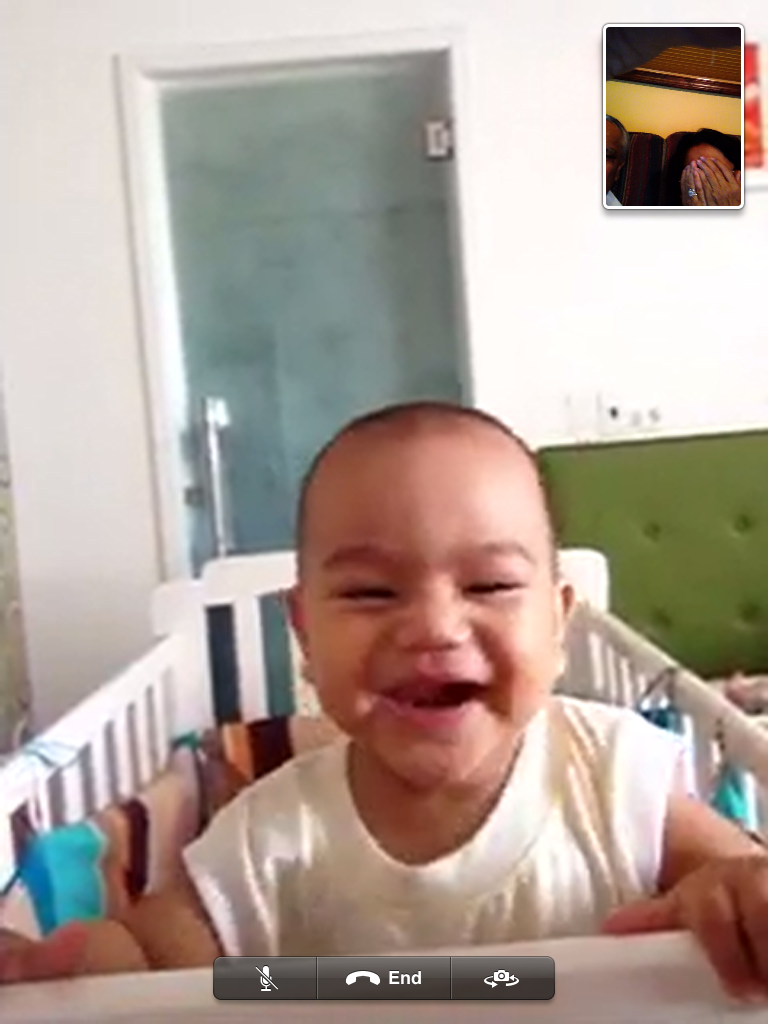
Nikhil learns that Obama won and approves!

Monday, November 5, 2012

How babies learn to talk-- part 2

A primer on how babies learn to talk:

He'll begin by using his tongue, lips, palate, and any emerging teeth to make sounds ("ooh"s and "ahh"s in the first month or two, babbling shortly thereafter). Soon those sounds will become real words ("mama" and "dada" may slip out and bring tears to your eyes as early as 4 to 5 months). From then on, your baby will pick up more words from you and everyone else around him. And sometime between 18 months and 2 years, he'll begin to form two- to three-word sentences. As your baby makes mental, emotional, and behavioral leaps, he'll increasingly be able to use words to describe what he sees, hears, feels, thinks, and wants.
Many researchers believe the work of understanding language begins even while a baby is still in utero. Just as your unborn baby gets used to the steady beat of your heart, he tunes into the sound of your voice. Days after birth, he's able to discern your voice among others. Crying is your baby's first form of communication. And one cry doesn't fit all: A piercing scream may mean he's hungry, while a whimpering, staccato cry may signal that he needs a diaper change. As he gets older, he'll develop a delightful repertoire of gurgles, sighs, and coos.

As for his ability to understand language, he's starting to pick up what words sound like and how sentences are structured as he listens to those around him. Linguists say babies as young as 4 weeks can distinguish between similar syllables, such as "ma" and "na." 
At 4-6 months, your child will start to babble, combining consonants and vowels (such as "baba" or "yaya"). The first "mama" or "dada" may slip out now and then. Though it's sure to melt your heart, your baby doesn't equate those words with you quite yet. That comes later, when he's almost a year old.

If you listen closely, your baby's attempts at talking will sound like stream-of-consciousness monologues in another language, with endless words strung together. Vocalization is a game to your baby, who's experimenting with using his tongue, teeth, palate, and vocal cords to make all sorts of funny noises. At this stage, babbling sounds the same, whether you speak English, French, or Japanese in your home. You may notice your child favoring certain sounds ("ka" or "da," for example), repeating them over and over because he likes the way they sound and how his mouth feels when he says them. 
At about 7 months, when he babbles and vocalizes now, your baby will sound as if he's making sense. That's because he's trying out tones and patterns similar to the ones you use. Foster his babbling by talking to him and reading to him.

The golden years begin at one year for now your child is using one or more words, and he knows what they mean. He'll even practice inflection, raising his tone when asking a question, saying "Up-py?" when he wants to be carried, for example. He's realizing the importance of language as he taps into the power of communicating his needs. 
By the time he is two years old, though he probably says about 50 to 70 words now, your child may understand as many as 200 words, many of which are nouns. Indeed between 18 and 20 months, he'll learn words at the rate of 10 or more a day (so watch your language!). 

Now he will even be able to string two words together, making basic sentences such as "Carry me." Your child will now begin to use three-word sentences and sing simple tunes. His sense of self will mature, and he'll start talking about what he likes and doesn't like, what he thinks and feels. Pronouns may confuse him, which is why he might say "Baby throw" instead of "I throw."

Between two and three years, your toddler may struggle for a while to find the appropriate volume to use when talking, but he'll learn soon enough. He's also starting to get the hang of pronouns, such as "I," "me," and "you." Between ages 2 and 3, your child's vocabulary will grow to up to 300 words. He'll string nouns and verbs together to form complete, simple sentences, such as "I go now."

And by the time he turns 3, your child will be a pretty sophisticated talker. He'll be able to carry on a sustained conversation and adjust his tone, speech patterns, and vocabulary to his conversation partner. For instance, he'll use simpler words with a peer, but be more verbal with you. By now he may be almost completely intelligible. He'll even be a pro at saying his name and age, and will proudly oblige when asked.


From then on, you will wonder why you wanted him to talk in the first place because he will never stop  !

Thursday, November 1, 2012

Why vote for Obama

This is for all those still on the fence regarding the presidential elections, a summary of why you should get off the fence and vote:

The New York Times is here

The Washington Post is here

The New Yorker is here

The Los Angeles Times is here

Now go and vote.

And vote for Obama!


The strength of political lies


Why You're Likely to Believe Political Lies


Have you ever wondered why people are persuaded by outright lies during political campaigns? And why lies tend to "stick" even after they're debunked by facts? 

Some new research sheds light on why this happens, at least in terms of people's thought processes, if not their underlying emotional drives.

It's a major phenomena: Prior to the 2012 election campaign, the most glaring lies in the political arena were that Obama is a Muslim and that global warming is a big hoax. For example, a Pew Research poll found that 30 percent of all Republicans described the president as Muslim. And others, such as Sen. James Inhofe have regularly called climate change "the greatest hoax" of all. And recently, Rep. Paul Broun -- who sits on the House Science Committee, ironically -- argued that evolution and the big bang are "lies from hell."

Currently, as the presidential campaign went into high gear after Labor Day, both sides regularly accuse each other of engaging in outright lies and extreme exaggeration about their positions and "facts," while insisting on the truthfulness of their own.

Lies tend to stick in people's minds, and can sway the outcome of elections, as well as public opinion in many arenas. So, what happens within our minds and emotions that make us receptive to lies, and then resistant to information that exposes the truth?

A study led by Stephan Lewandowsky of the University of Western Australia explains part of what may happen. The researchers found that "Weighing the plausibility and the source of a message is cognitively more difficult than simply accepting that the message is true -- it requires additional motivational and cognitive resources."If the subject isn't very important to you or you have other things on your mind, misinformation is more likely to take hold, according to the researchers. They point out that rejecting false information requires more cognitive effort than just taking it in. That is, weighing how plausible a message is, or assessing the reliability of its source, is more difficult, cognitively, than simply accepting that the message is true. In short, it takes more mental work. And if the topic isn't very important to you or you have other things on your mind, the misinformation is more likely to take hold.

.Moreover, when you do take the time to valuate a claim or allegation, you're likely to pay attention just to a limited number of features, the study found. For example: Does the information fit with other things you already believe? Does it make a coherent story with what you already know? Does it come from a credible source? And do others believe it?  Your information milieu may reinforce information consistent with what you already "know" or are selectively exposed to. Similarly, as the researchers concluded, lies and misinformation may become deeply rooted when it conforms to preexisting political, religious, or other views.

Even worse, attempts to correct misinformation can backfire and actually increase the effect of the false belief!

 A good, recent example is the report that unemployment dropped below 8 percent during September. The GOP had emphasized their conviction that unemployment would remain above 8 percent -- and benefit Romney's campaign. However, following the report that unemployment dropped to 7.8 percent during September, several Republican spokesmen immediately claimed that the figures had been falsified. And despite factual corroboration that the numbers were accurately determined, some doubled-down on their allegation that a conspiracy to cook the numbers must have occurred. "

This persistence of misinformation has fairly alarming implications in a democracy because people may base decisions on information that, at some level, they know to be false," Lewandowsky states. “At an individual level, misinformation about health issues -- for example, unwarranted fears regarding vaccinations or unwarranted trust in alternative medicine-- can do a lot of damage. 

At a societal level, persistent misinformation about political issues can create considerable harm. On a global scale, misinformation about climate change is currently delaying mitigative action.”The researchers offer some guidelines that may help people focus on information that is true and accurate. For example, providing people with a narrative that replaces the gap left by false information; emphasizing the facts you want to highlight; keeping the information you want people to take away simple and brief; and strengthening your message through repetition.

These are useful strategies and can help penetrate falsehoods that people have absorbed, and provide them with clear, truthful information in contrast. But I think they only go so far, because the hidden factor is more emotional and attitudinal. It's the person's internal drivers: the fears, needs and prejudices that are largely unconscious, and very resistant to information that challenges or conflicts with them in ways that are threatening. So it's not just a matter of cognitive factors that make one receptive to lies or resistant to acknowledging the truth. It's one's entire psychology. That is, many emotional needs or conflicts may fuel one's cognitive, conscious beliefs and attitudes. And the latter may only tighten and become more deeply entrenched when challenged. It's much harder to address those. What may penetrate is empathic, supportive communication that recognizes deeply help positions. This may be a bridge to messages that enable one to examine one's own beliefs and become more receptive to the truth.

How to talk to babies


Babies have a way with us. We stare unabashedly at them and smile and make silly faces. Our speech changes, too. Baby talk, known among researchers asinfant-directed speechmotherese, and parentese (as fathers are not immune), is well—even exhaustively—studied.
When we talk to babies, we tend to use shorter, simpler sentences, which we utter more slowly. Our pitch becomes higher and more variable, our affect warmer, and our vowels more exaggerated. “Oh suuuch a niiice baaaby!” we coo. And by “we,” I mean just about everyone everywhere; baby talk exists, in a (somewhat) similar form, in every language in which it has been studied.
So why do we do this? For one, infants like baby talk. Pretty much from the get-go they’ll listen to it longer than they’ll listen to speech directed toward adults. 
Baby talk is also a particularly efficient conduit of speakers’ emotions and intentions. All speech transmits this information to some degree; a non-English speaker can nonetheless listen to an English speaker’s words and do a decent job of deciding whether they’re listening to chastisement, approval, comfort-giving, or attention-seeking. But present that non-English speaker with English baby talk and she’ll do an even better job. Baby talk, with its theatrical sing-songedness, wears its heart on its sleeve.
Finally, and slightly more controversially, baby talk may actually help infants learn their native language. 
So is baby talk a happy accident, or a smart parenting strategy developed over the ages? 
We may never know exactly how it came to be, but we do know that we speak differently to babies, to whom we hope to teach language, than to our pets, whom we just hope to house-train. When talking to pets, we do not hyper-articulate our vowels. No matter how clearly we sound our vowels, we know in our heart of hearts that our cat will remain stubbornly ignorant of the intricacies of the English language.

Here are some tips for talking to your baby:
  • Look at your baby's eyes while you are talking to her.
  • Call your baby by her name.
  • Keep your talk simple. Say "pretty baby." Use the words "mommy" and "daddy" when you talk to her.
  • Watch for your baby's expressions and listen to her sounds. Make these same sounds and facial expressions back to her.
  • Add gestures to your talk. Say "wave bye-bye to the dog" as you wave to the dog.
  • Ask your baby questions. "Would Maria like to have her milk now?" "Does Maria want to go outside?" Ask the questions even though she can't answer.
  • Talk about what you are doing. As you dress, bathe and change your baby, talk about what you're doing.
  • Read to your baby. Babies love nursery rhymes and poems. You can even use a lively voice and read your favorite magazine or book to her. If you can, use books with stories that include a baby, a rattle or other common things. (You can find lots of children's books at your public library.)
  • Sing to your baby. It is important while she begins to learn language skills.
  • Watch for signals from your baby when you are talking to her. If she is smiling and keeping eye contact, she is saying she wants you to keep on talking.